A tankless water heater does not store hot water at all. It waits for a faucet to open, senses the flow, fires a burner or energizes its elements, and heats water as it races through a compact heat exchanger. That on-demand design is efficient and space-saving, but it packs a lot of sensors and controls into one small cabinet, and every one of them has to agree before you get hot water. When one of them objects, the unit shuts down and posts an error code. In Billings, MT, the usual culprits are mineral scale coating the heat exchanger, a flow sensor that no longer registers demand, an igniter or flame rod that cannot prove the flame, and venting or gas supply problems that trip the unit's safety limits.
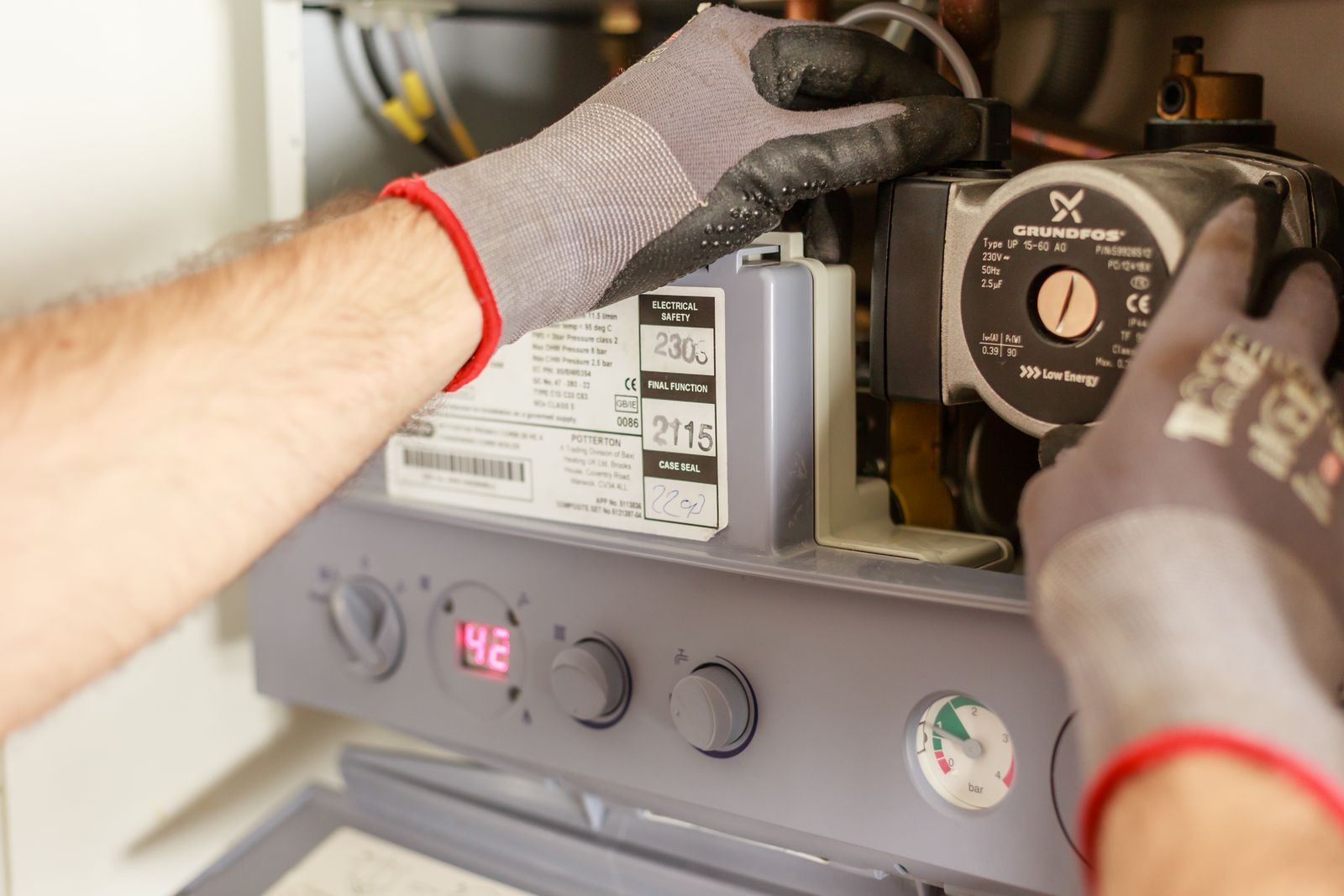
Our approach to tankless repair is simple: measure first, replace second. When we arrive at your Billings home, we record the active code and the unit's fault history, then work through the systems behind it. Flow sensors are checked with water running to confirm they report demand correctly. Flame rods and igniters are tested electrically. Gas pressure is read at the inlet with the burner at maximum, because a line that holds steady at idle can sag badly under full load. The vent and air intake are inspected end to end, and the heat exchanger is judged by the temperature rise it achieves at a known flow. By the time we recommend a repair, we know it is the right one.
After the fault is pinned down, most repairs are finished in a single visit. We descale heat exchangers with a pump and descaling solution circulated through the service valves, replace worn flow sensors, igniters, flame rods, thermistors, and combustion fans, clean inlet filter screens, and correct venting problems that trip pressure switches. When the real issue is a gas line sized for the old tank heater, we tell you plainly and quote the correct pipe run, because no amount of part swapping will fix a unit that is starved for fuel. If you are fighting a cold-water sandwich, we explain whether it is normal behavior for your model or a sign of a setting, fixture, or recirculation problem we can correct. Call (406) 233-1843 and we will get your hot water flowing again.
Our most requested service is Water Heater Repair in Billings. Start there if you're not sure what you need.
Signs You Need Tankless Water Heater Repair in Billings
A heater that is starting to struggle rarely hides it for long, and the clues are easy to spot once you know them. Here are the most common indicators that it's time to call a professional:
- Lukewarm water whenever two fixtures run at the same time
- A cold-water sandwich that has gotten noticeably worse
- A fault code on the front panel and no hot water
- Leaks under the unit or around its water connections
- Hot water that fluctuates even though nobody touched the faucet
- New whistling, roaring, or rumbling from the unit
- A clicking igniter with no flame, or a flame that lights and quickly drops out
- A heater that only fires when water runs at full blast
Act Before It Gets Worse
A little rust-colored water or a relief valve that drips now and then can be the first hint of a tank that is close to the end. Don't wait. Get Billings Water Heater on the phone at (406) 233-1843 and we'll get a technician scheduled.
No Hot Water? We Can Help.
Call Billings Water Heater for fast, reliable service.
Call (406) 233-1843 NowWhat Homeowners Ask Us Most
Why Hire a Professional for Tankless Water Heater Repair?
Consider the risks first. A gas-fired tankless heater can burn nearly 200,000 BTU per hour at full fire, and its vent is the only thing carrying carbon monoxide out of the house; a joint that pulls loose or an intake that gets blocked changes that in a hurry. On the electric side, the loads are large, frequently more than 100 amps spread over several 240-volt circuits. Then there is the diagnostic puzzle. Error codes point to a system, not a part, so a flow sensor fault, a scaled heat exchanger, and a bad thermistor can look nearly identical on the display, and guessing gets expensive.
Calling a pro often costs less than trial and error. Our technicians do not guess at error codes. They test flow sensors with water moving, measure flame rod signal, confirm igniter resistance, read inlet gas pressure at full fire, and check the vent from end to end. When scale is the problem, we flush it out properly and rinse the system before the unit goes back in service. And because some tankless problems, like an undersized gas line or a cracked heat exchanger, are not solved by parts at all, we tell you so directly, before you commit to anything.
Step by Step: How a Visit Works
Good water heater work comes down to a consistent routine, and ours starts with a real diagnosis instead of a guess. Here's how we handle tankless water heater repair from start to finish:
Code & Fault History Review
A code points us in a direction, and testing finishes the job. Flow sensor output, flame signal, igniter resistance, inlet gas pressure, and vent condition all get checked before any part is replaced.
What We Found & What It Costs
We explain the fault in plain language and put a firm quote in front of you first. When a repair no longer makes sense on an aging unit, you hear that from us directly.
Same-Visit Fix
We carry the parts that fail most on tankless units, so flow sensors, igniters, flame rods, and thermistors are usually replaced on the spot, and a descaling flush takes about an hour.
Verified Temperature Rise
We never assume a fix worked. We test the unit at low flow and at full demand, confirm a steady outlet temperature, and verify that the code is cleared and does not return.
Questions About Tankless Water Heater Repair?
Our technicians can assess your water heater and recommend the option that actually makes sense.
Get Help: (406) 233-1843How to Prevent Water Heater Problems
Most of the failures we see could have been delayed for years with basic upkeep. Here's where to begin:
- Treat a code that returns after a reset as a symptom worth diagnosing, not ignoring
- Rinse the small filter screen on the cold inlet every few months
- If scale comes back quickly, add a softener or a scale-prevention cartridge on the cold inlet
- Keep the unit powered during freezing weather so its freeze protection can work
- Have the gas line evaluated whenever you add a range, dryer, or fireplace
- Clear debris, snow, and dryer lint away from the vent and intake openings
- Schedule a descaling flush every year; hard water may call for one every six months
Doing It Yourself vs. Hiring a Technician
Online videos may help in a pinch, yet lasting repairs and code-compliant installs depend on correct venting, proper relief valve discharge piping, and a trained technician. A side-by-side look:
| Factor | DIY Attempt | Professional Service |
|---|---|---|
| Reading the Code | Look up the code and replace a guess | Code confirmed by component testing |
| Scale Removal | Partial flush that leaves scale behind | Full descale, then a thorough rinse |
| Gas & Venting | No way to test pressure at full fire | Gas pressure and vent run verified |
| Board & Wiring | Exposed wiring and sensitive electronics | Circuits and board checked with proper tools |
| Parts | Wrong sensor ordered on a guess | Model-matched parts, often on the truck |
| Result | Temporary fix at best | Lasting repair, confirmed by testing |
Book a Visit Today
Get your hot water back before a small fault turns into a flooded floor. Billings Water Heater is ready to respond fast.
Tap to Call (406) 233-1843Areas We Serve for Tankless Water Heater Repair
Our technicians handle tankless water heater repair throughout Billings and the surrounding communities, with the same upfront pricing everywhere we work.